When a new building is completed the owners corporation (OC) manager is usually appointed by the developer long before any owners move in.
These early appointments often receive little scrutiny which can leave OCs with management arrangements that cost more than they should and offer limited oversight.
A building in St Kilda uncovered this firsthand. Once the owners took control they reviewed their management documents and ran a tender to understand whether their arrangement was appropriate.
Their experience highlights why owners should revisit these early decisions and consider whether the inherited manager is still the best fit for their community.
Key Takeaways:
- Developer-appointed OC managers are chosen without owner input, often resulting in higher fees and inflexible terms. Reviewing these arrangements once owners take control is essential.
- A St Kilda building saved nearly 50% in annual management costs by running a competitive tender. The review uncovered $7,000–$8,000 in unnecessary expenses.
- Reassessing inherited OC contracts often exposes avoidable costs and outdated terms. A transparent tender helps Committees secure better value and service.
Why developer-appointed OC managers matter
When a plan of subdivision is registered and an OC is created, the developer is the only member of the OC until lots are sold. This gives the developer full control over appointing the first OC manager and setting early administrative arrangements.
These decisions often carry through once owners move in and can influence management fees, service quality and how effectively the building is supported in its first years.
How OC managers are appointed in new developments
When land is subdivided and an OC is created Section 66 of the OC Act 2006 requires the developer to convene the first Annual General Meeting (AGM) within six months of registering the plan of subdivision.
Until the lots are sold and settled the developer is the sole owner. This gives the developer complete control over early decisions including:
- appointing the OC manager
- approving the first budget and levies
- adopting rules and administrative procedures
For new owners these arrangements are already in place with no chance to review them at the start.
Why the first AGM is often a “paper meeting”
In many new developments the first AGM does not occur as a traditional meeting. It is usually a paper meeting where resolutions are recorded without discussion or input from future owners.
OC management companies often seek appointment at this stage because the developer is the only decision-maker. As a result:
- fees may not align with market rates
- contract terms may favour the manager
- owners have limited insight into disbursements or service expectations
Although this process complies with legislation it can prioritise convenience for the developer rather than long-term value for the OC.
What happens when owners take control
Once lots settle and owners form a Committee they often start to notice concerns such as:
- high management fees
- limited transparency
- poor communication
- outdated or restrictive contract terms
This is usually when Committees begin to question whether the inherited OC manager is suitable for their building.
The St Kilda OC that contacted us was in this position.
How a St Kilda Committee reduced its management fees by 50%
A Committee in St Kilda approached us to review their OC management and confirm whether their building was being managed effectively. What we found showed how a closer look at documents and costs can create meaningful savings for an OC.
Reviewing the existing arrangement
The Committee contacted us for help with understanding their current management arrangement.
After meeting with the Committee we reviewed their OC management documents and financials. This included:
- management agreements
- financial statements
- disbursements
- general service performance
The review showed that the building was paying more than it needed to for OC management.
Running a competitive management tender
We then conducted a management tender for the Committee. From this process we presented three experienced and proficient OC managers for the Committee to consider.
Each provider was knowledgeable, ethical and capable and we had worked with them for many years.
The result
The difference appeared in the numbers. All three companies offered fees that were significantly lower than the existing arrangement with savings of about 7,000 to 8,000 dollars per year.
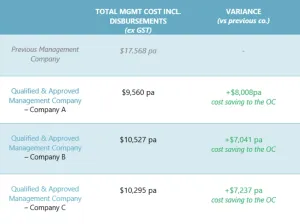
This was a reduction of nearly 50 percent in annual management costs as shown in the comparison image above.
By changing managers the Committee achieved immediate savings and secured a service that better supported the needs of their building.
Why cost gaps exist between developer-appointed and independently chosen OC managers
Cost differences often appear because the initial appointment is made by the developer without competition or owner involvement.
Fees and terms are set early and are not usually reviewed until the Committee takes control of the building. This can leave OCs with arrangements that do not reflect current market rates or the needs of the community.
Once owners assume responsibility a review often highlights opportunities to:
- reduce costs
- update service agreements
- remove unnecessary disbursements
- improve governance and communication
Running a competitive tender allows Committees to compare services and pricing in a transparent way and helps ensure the OC receives appropriate value.
Thinking about changing your OC manager?
Changing managers does not have to be complex or disruptive when it is handled with the right support.
At Owners Corporation Victoria, we have dedicated years to helping Committees review their arrangements and understand whether their building is receiving the service and value it should.
A periodic review can highlight opportunities for cost savings, stronger governance and a better level of service for your community. If your Committee is considering a change or would like an independent assessment of its current management, our consultants are ready to help.